Selasa, 19 Januari 2016
Modern Art
Modern art includes artistic work produced during the period extending roughly from the 1860s to the 1970s, and denotes the style andphilosophy of the art produced during that era.[1] The term is usually associated with art in which the traditions of the past have been thrown aside in a spirit of experimentation.[2] Modern artists experimented with new ways of seeing and with fresh ideas about the nature of materials and functions of art. A tendency away from the narrative, which was characteristic for the traditional arts, toward abstraction is characteristic of much modern art. More recent artistic production is often called contemporary art or postmodern art.
Modern art begins with the heritage of painters like Vincent van Gogh, Paul Cézanne, Paul Gauguin, Georges Seurat and Henri de Toulouse-Lautrec all of whom were essential for the development of modern art. At the beginning of the 20th century Henri Matisse and several other young artists including the pre-cubists Georges Braque, André Derain, Raoul Dufy, Jean Metzinger and Maurice de Vlaminck revolutionized the Paris art world with "wild", multi-colored, expressive landscapes and figure paintings that the critics calledFauvism. Henri Matisse's two versions of The Dance signified a key point in his career and in the development of modern painting.[3] It reflected Matisse's incipient fascination with primitive art: the intense warm color of the figures against the cool blue-green background and the rhythmical succession of the dancing nudes convey the feelings of emotional liberation and hedonism.
Initially influenced by Toulouse-Lautrec, Gauguin and other late 19th century innovators, Pablo Picasso made his first cubist paintings based on Cézanne's idea that all depiction of nature can be reduced to three solids: cube, sphere and cone. With the painting Les Demoiselles d'Avignon (1907), Picasso dramatically created a new and radical picture depicting a raw and primitive brothel scene with five prostitutes, violently painted women, reminiscent of African tribal masks and his own new Cubist inventions. Analytic cubism was jointly developed by Pablo Picasso and Georges Braque, exemplified by Violin and Candlestick, Paris, from about 1908 through 1912. Analytic cubism, the first clear manifestation of cubism, was followed by Synthetic cubism, practiced by Braque, Picasso, Fernand Léger, Juan Gris, Albert Gleizes, Marcel Duchamp and several other artists into the 1920s. Synthetic cubism is characterized by the introduction of different textures, surfaces, collage elements, papier collé and a large variety of merged subject matter.
Art History Timeline
The history of art is immense, the earliest cave paintings pre-date writing by almost 27,000 years! If you're interested in art history, the first thing you should do is take a look at this table which briefly outlines the artists, traits, works, and events that make up major art periods and how art evolved to present day:
| Art Periods/ Movements | Characteristics | Chief Artists and Major Works | Historical Events |
|---|---|---|---|
| Stone Age (30,000 b.c.–2500 b.c.) | Cave painting, fertility goddesses, megalithic structures | Lascaux Cave Painting, Woman of Willendorf, Stonehenge | Ice Age ends (10,000 b.c.–8,000 b.c.); New Stone Age and first permanent settlements (8000 b.c.–2500 b.c.) |
| Mesopotamian (3500 b.c.–539 b.c.) | Warrior art and narration in stone relief | Standard of Ur, Gate of Ishtar, Stele of Hammurabi's Code | Sumerians invent writing (3400 b.c.); Hammurabi writes his law code (1780 b.c.); Abraham founds monotheism |
| Egyptian (3100 b.c.–30 b.c.) | Art with an afterlife focus: pyramids and tomb painting | Imhotep, Step Pyramid, Great Pyramids, Bust of Nefertiti | Narmer unites Upper/Lower Egypt (3100 b.c.); Rameses II battles the Hittites (1274 b.c.); Cleopatra dies (30 b.c.) |
| Greek and Hellenistic (850 b.c.–31 b.c.) | Greek idealism: balance, perfect proportions; architectural orders(Doric, Ionic, Corinthian) | Parthenon, Myron, Phidias, Polykleitos, Praxiteles | Athens defeats Persia at Marathon (490 b.c.); Peloponnesian Wars (431 b.c.–404 b.c.); Alexander the Great's conquests (336 b.c.–323 b.c.) |
| Roman (500 b.c.– a.d. 476) | Roman realism: practical and down to earth; the arch | Augustus of Primaporta, Colosseum, Trajan's Column, Pantheon | Julius Caesar assassinated (44 b.c.); Augustus proclaimed Emperor (27 b.c.); Diocletian splits Empire (a.d. 292); Rome falls (a.d. 476) |
| Indian, Chinese, and Japanese(653 b.c.–a.d. 1900) | Serene, meditative art, and Arts of the Floating World | Gu Kaizhi, Li Cheng, Guo Xi, Hokusai, Hiroshige | Birth of Buddha (563 b.c.); Silk Road opens (1st century b.c.); Buddhism spreads to China (1st–2nd centuries a.d.) and Japan (5th century a.d.) |
| Byzantine and Islamic (a.d. 476–a.d.1453) | Heavenly Byzantine mosaics; Islamic architecture and amazing maze-like design | Hagia Sophia, Andrei Rublev, Mosque of Córdoba, the Alhambra | Justinian partly restores Western Roman Empire (a.d. 533–a.d. 562); Iconoclasm Controversy (a.d. 726–a.d. 843); Birth of Islam (a.d. 610) and Muslim Conquests (a.d. 632–a.d. 732) |
| Middle Ages (500–1400) | Celtic art, Carolingian Renaissance, Romanesque, Gothic | St. Sernin, Durham Cathedral, Notre Dame, Chartres, Cimabue, Duccio, Giotto | Viking Raids (793–1066); Battle of Hastings (1066); Crusades I–IV (1095–1204); Black Death (1347–1351); Hundred Years' War (1337–1453) |
| Early and High Renaissance (1400–1550) | Rebirth of classical culture | Ghiberti's Doors, Brunelleschi, Donatello, Botticelli, Leonardo, Michelangelo, Raphael | Gutenberg invents movable type (1447); Turks conquer Constantinople (1453); Columbus lands in New World (1492); Martin Luther starts Reformation (1517) |
| Venetian and Northern Renaissance (1430–1550) | The Renaissance spreads north- ward to France, the Low Countries, Poland, Germany, and England | Bellini, Giorgione, Titian, Dürer, Bruegel, Bosch, Jan van Eyck, Rogier van der Weyden | Council of Trent and Counter-Reformation (1545–1563); Copernicus proves the Earth revolves around the Sun (1543 |
| Mannerism (1527–1580) | Art that breaks the rules; artifice over nature | Tintoretto, El Greco, Pontormo, Bronzino, Cellini | Magellan circumnavigates the globe (1520–1522) |
| Baroque (1600–1750) | Splendor and flourish for God; art as a weapon in the religious wars | Reubens, Rembrandt, Caravaggio, Palace of Versailles | Thirty Years' War between Catholics and Protestants (1618–1648) |
| Neoclassical (1750–1850) | Art that recaptures Greco-Roman grace and grandeur | David, Ingres, Greuze, Canova | Enlightenment (18th century); Industrial Revolution (1760–1850) |
| Romanticism (1780–1850) | The triumph of imagination and individuality | Caspar Friedrich, Gericault, Delacroix, Turner, Benjamin West | American Revolution (1775–1783); French Revolution (1789–1799); Napoleon crowned emperor of France (1803) |
| Realism (1848–1900) | Celebrating working class and peasants;en plein airrustic painting | Corot, Courbet, Daumier, Millet | European democratic revolutions of 1848 |
| Impressionism (1865–1885) | Capturing fleeting effects of natural light | Monet, Manet, Renoir, Pissarro, Cassatt, Morisot, Degas | Franco-Prussian War (1870–1871); Unification of Germany (1871) |
| Post-Impressionism (1885–1910) | A soft revolt against Impressionism | Van Gogh, Gauguin, Cézanne, Seurat | Belle Époque (late-19th-century Golden Age); Japan defeats Russia (1905) |
| Fauvism and Expressionism (1900–1935) | Harsh colors and flat surfaces (Fauvism); emotion distorting form | Matisse, Kirchner, Kandinsky, Marc | Boxer Rebellion in China (1900); World War (1914–1918) |
| Cubism, Futurism, Supremativism, Constructivism, De Stijl (1905–1920) | Pre– and Post–World War 1 art experiments: new forms to express modern life | Picasso, Braque, Leger, Boccioni, Severini, Malevich | Russian Revolution (1917); American women franchised (1920) |
| Dada and Surrealism(1917–1950) | Ridiculous art; painting dreamsand exploring the unconscious | Duchamp, Dalí, Ernst, Magritte, de Chirico, Kahlo | Disillusionment after World War I; The GreatDepression (1929–1938); World War II (1939–1945) and Nazi horrors; atomic bombs dropped on Japan (1945) |
| Abstract Expressionism (1940s–1950s) and Pop Art (1960s) | Post–World War II: pure abstraction and expression without form; popular art absorbs consumerism | Gorky, Pollock, de Kooning, Rothko, Warhol, Lichtenstein | Cold War and Vietnam War (U.S. enters 1965); U.S.S.R. suppresses Hungarian revolt (1956) Czechoslovakian revolt (1968) |
| Postmodernism and Deconstructivism (1970– ) | Art without a center and reworking and mixing past styles | Gerhard Richter, Cindy Sherman, Anselm Kiefer, Frank Gehry, Zaha Hadid | Nuclear freeze movement; Cold War fizzles; Communism collapses in Eastern Europe and U.S.S.R. (1989–1991) |
Madame Tussauds
Madame Tussauds
Museum
Madame Tussauds is a famous wax museum in London , England , with branches in several major cities in the world . The museum was first founded by wax sculptor Marie Tussaud.
Marie Tussaud was born as Marie Grosholtz in 1761 in Strasbourg, France. Her mother worked as a housekeeper for Dr. Philippe Curtius inBern, Switzerland, who was a physician skilled in wax modelling. Curtius taught Tussaud the art of wax modelling.
Tussaud created her first wax sculpture, of Voltaire, in 1777.[4] Other famous people she modelled at that time include Jean-Jacques Rousseau and Benjamin Franklin. During the French Revolution she modelled many prominent victims. In her memoirs she claims that she would search through corpses to find the severed heads of executed citizens, from which she would make death masks. Her death masks were held up as revolutionary flags and paraded through the streets of Paris. Following the doctor's death in 1794, she inherited his vast collection of wax models and spent the next 33 years travelling around Europe. She married to Francois Tussaud in 1795 lent a new name to the show: Madame Tussaud's. In 1802 she went to London, having accepted an invitation from Paul Philidor, a magic lantern andphantasmagoria pioneer, to exhibit her work alongside his show at the Lyceum Theatre, London. She did not fare particularly well financially, with Philidor taking half of her profits. As a result of the Napoleonic Wars, she was unable to return to France, so she traveled throughout Great Britain and Ireland exhibiting her collection. From 1831 she took a series of short leases on the upper floor of "Baker Street Bazaar" (on the west side of Baker Street, Dorset Street and King Street),[5] which later featured in the Druce-Portland case sequence of trials of 1898–1907. This became Tussaud's first permanent home in 1836.[6] One of the main attractions of her museum was the Chamber of Horrors.
- The Sleeping Beauty is the oldest existing figure on display. It was modeled afterMadame du Barry. She appears asleep and a device in her chest makes it seem as if she were breathing.
- Madame Tussaud herself at Madame Tussauds in London
- Benny Hill (Credited Tussauds Gard)
- John Wayne (London)
- Olga Korbut (London)
- Johnny Depp as Jack Sparrow
Rabu, 13 Januari 2016
Apa sih itu POP ART??
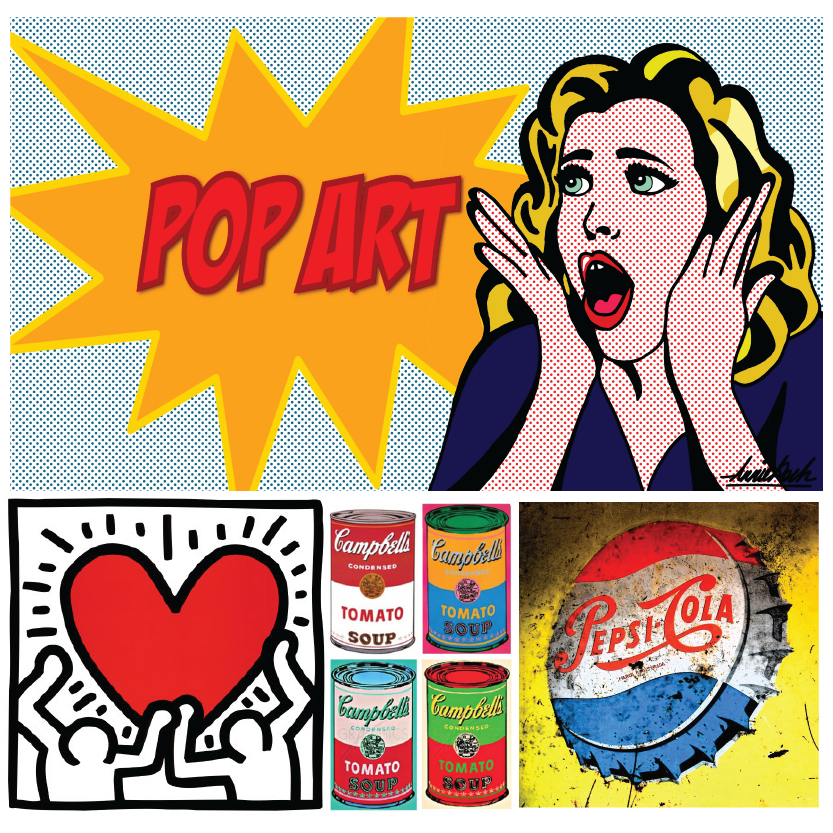
Pop art berasal dari kata Popular art. Pop art adalah aliran seni yang memanfaatkan simbol-simbol dan gaya visual yang berasal dari media massa yang populer seperti koran, tv, iklan dll. Pop Art merupakan sebuah gerakan seni yang muncul di Inggris pada tahun 1950-an di awal-awal jaman post modern art, Jaman dimana semua orang mulai bosan dengan gaya Modern. Pop Art merupakan seni yang mendobrak batas-batas artian seni yang agung.

Pada saat itu seni hanyalah sebuah hal yang bisa dinikmati kalangan kelas atas, dengan adanya gerakan Pop Art, seni dapat dinikmati oleh semua kalangan, mulai dari golongan bawah hingga golongan atas. Seniman Pop Art yang paling terkenal adalah Andy Warhol, dengan karyanya yang menggambarkan wajah Marylin Monroe yang disajikan dengan warna-warna komplemen yang tegas. Andy Warhol adalah seniman Amerika, dialah yang dipercaya mulai mempopulerkan Pop Art di Amerika.
Ciri khas Pop Art adalah penggabungan foto serta permainan warna yang berani, kadang disertai penggunaan simbol-simbol untuk menyampaikan pesan si pembuatnya. Desain Pop Art seringkali menggunakan teks berukuran besar dengan stroke yang tebal, D.Frida (Perkuliahan).
Semoga informasi di atas bisa menambah wawasan kamu dalam dunia Art/Seni..
silahkan tinggalkan komentar atau kritik saran kamu..
Terimakasih........
Pop art berasal dari kata Popular art. Pop art adalah aliran seni yang memanfaatkan simbol-simbol dan gaya visual yang berasal dari media massa yang populer seperti koran, tv, iklan dll. Pop Art merupakan sebuah gerakan seni yang muncul di Inggris pada tahun 1950-an di awal-awal jaman post modern art, Jaman dimana semua orang mulai bosan dengan gaya Modern. Pop Art merupakan seni yang mendobrak batas-batas artian seni yang agung.

Pada saat itu seni hanyalah sebuah hal yang bisa dinikmati kalangan kelas atas, dengan adanya gerakan Pop Art, seni dapat dinikmati oleh semua kalangan, mulai dari golongan bawah hingga golongan atas. Seniman Pop Art yang paling terkenal adalah Andy Warhol, dengan karyanya yang menggambarkan wajah Marylin Monroe yang disajikan dengan warna-warna komplemen yang tegas. Andy Warhol adalah seniman Amerika, dialah yang dipercaya mulai mempopulerkan Pop Art di Amerika.
Ciri khas Pop Art adalah penggabungan foto serta permainan warna yang berani, kadang disertai penggunaan simbol-simbol untuk menyampaikan pesan si pembuatnya. Desain Pop Art seringkali menggunakan teks berukuran besar dengan stroke yang tebal, D.Frida (Perkuliahan).
Semoga informasi di atas bisa menambah wawasan kamu dalam dunia Art/Seni..
silahkan tinggalkan komentar atau kritik saran kamu..
Terimakasih........
Selasa, 12 Januari 2016
POP ART
POP ART??? What is POP ART??
Definition:Pop Art is a modern art movement, started in the 1950s, which uses the imagery, styles, and themes of advertising, mass media, and popular culture. Richard Hamilton, Roy Lichtenstein and Andy Warhol are among the best known Pop artists.
Inspiration and ideas for Pop Art paintings were drawn from the commercial and consumer aspects of everyday life, particularly in American culture.
"Pop art celebrated objects and ideas that were not only familiar but also banal in their content."1
In developing its distinctive style, Pop Art built on both abstract art and commercial advertising styles, the way these reduced or simplified reality and perspective. Some pop artists also used commercial printing techniques to produce multiples.
Pop Art paintings don't show evidence of the application of paint, they don't have hidden symbolism (though the choice of object depicted may have some intended symbolism), and they don't use the traditional techniques of perspective to create an illusion of reality and location in the painting.
Pop Art "connected to contemporary anti-painterly developments in abstract painting through their deliberate withholding of personal commentary and in the care they took to reproduce their borrowed images with no addition of pictorial illusion."2 As a style, Pop Art often looks flat, with opaque color rather than having depth created by layers of transparent, glazed color. Once you're familiar with a few Pop Art paintings, it's a distinctive art style that's quite easy to recognize.

Pop Art Recommended for Beginner to Intermediate Level Photoshop Users
If you are a fan of pop art then you’re probably already well acquainted with the workRoy Lichtenstein. Roy Lichtenstein became one of the leading pop artists of the sixties with his comic-strip paintings. Drowning Girl 1963, shown left, is one of his better known works and is a good example of the design features in his most famous pieces. Notice the thick lines, bold colors, and thought bubble. His work also often included boxed captions and words such as “WHAAM!”, commonly found in comic books.
Benday dots were Lichtenstein’s trademark. Benday dots are a printing process which combines two (or more) different small, coloured dots to create a third colour. Back in the day, pulp comic books used benday dots in primary colours to inexpensively create the secondary colours such as flesh tone.
You can create the benday dot effect by using the Colour Halftone filter found in Adobe Photoshop, however in this tutorial I’m going to show you a way to create a fantastic looking black and white Halftone Pattern. “Why?”, because I like the look of it better.
Due to the vivid colors, the pop art that you will create using this tutorial will look fantastic if you get it printed at your local print shop. If you are going to get it printed, in the beginning change the resolution to 300dpi (Image >> Image Size) and at the end of the tutorial change the mode to CMYK (adjust colours if necessary).
There are 2 parts to this tutorial…
PART 1. Creating the Half Tone Shading
PART 2. Adding Color
I suggest that you read through this tutorial first before beginning…
PART 1. Creating the Half Tone Shading
Langganan:
Komentar (Atom)